Two Futures
Why We Build for Humans When AI Can Make Everything
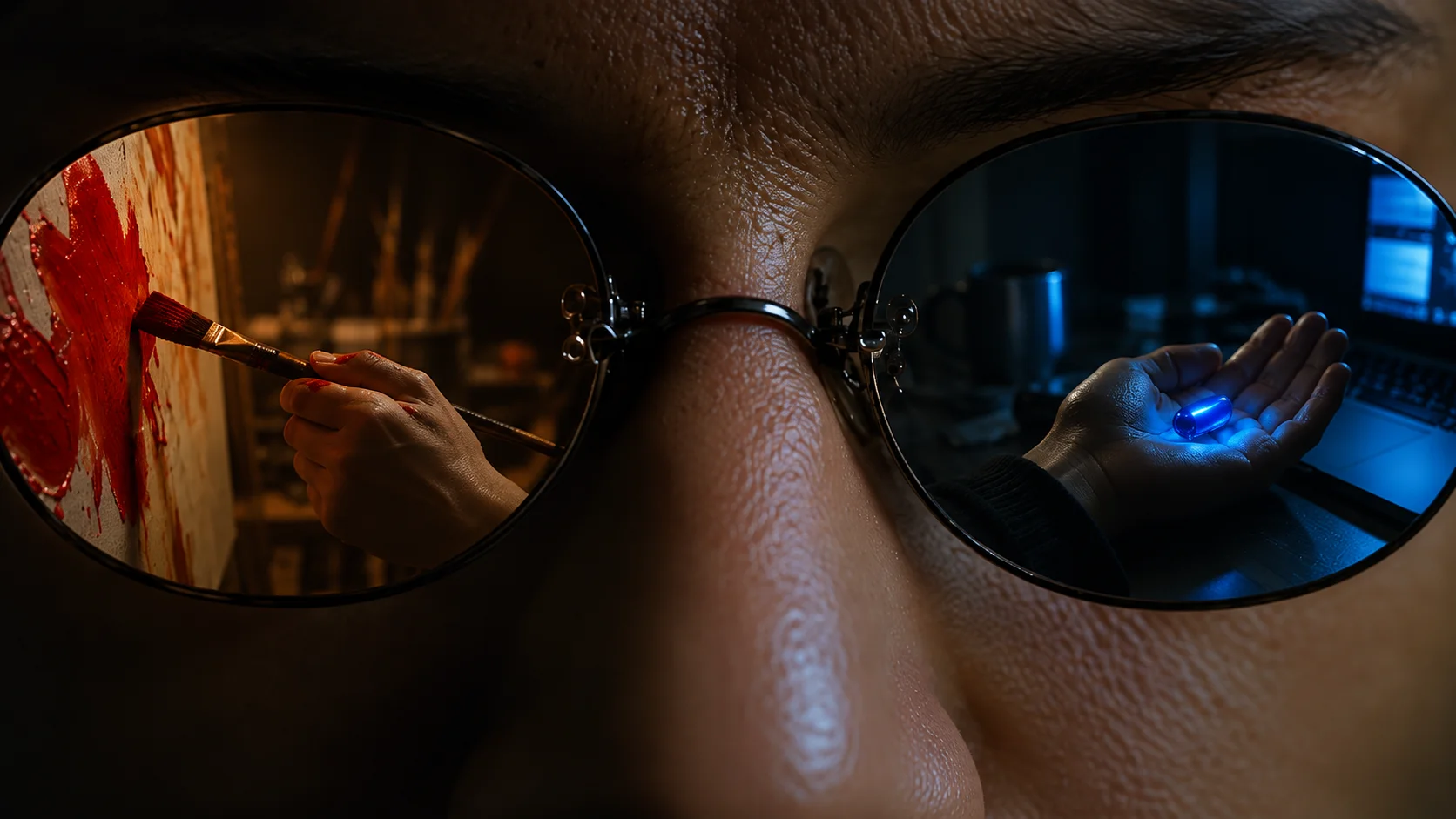
Cover: intent by the author, execution by AI
In The Matrix (1999), Morpheus sits in a dimly lit room and holds out both hands to Neo.
Take the blue pill, and the story ends. You wake up in your own bed and believe whatever you want to believe. Take the red pill, and you stay in Wonderland to see how deep the rabbit hole goes.
Today, AI is holding out the same two hands to every one of us.
In one hand is an ever-better "final answer." No more racking your brain, no more tearing things down and starting over. Just say what you need, and the result appears, often better than anything you would have made yourself.
In the other hand is only a paintbrush. It promises nothing. What you truly want reveals itself slowly, and only as you keep painting.
But just like in the film, most people never realize they are standing in front of this choice.
The First Future
In 1930, John Maynard Keynes made a bold prediction in Economic Possibilities for our Grandchildren: in a hundred years, technological progress would raise living standards several times over, and people would need to work only around fifteen hours a week.
Now imagine that, a few years from now, the prophecy finally comes true.
Everyone works just ten hours a week. AI has taken over most decisions and most creative work, and robots staff nearly every production line. A university degree has become an investment with a dismal return. Most universities have closed, apart from a handful of schools reserved for the children of the elite.
On Wednesday morning, a driverless taxi takes you to the office.
The morning brings the weekly creative meeting. AI has prepared five brand concepts for a new product. One by one they unfold across the big screen, each of them beautiful.
Everyone votes, and the third one wins.
Someone remarks that in the old days, this would have taken a whole team a month. Everyone smiles.
The meeting ends. That was the whole week's work.
Back home, the system generates a film made just for you. You fast-forward five minutes, then turn it off. Five seconds later, a new one is ready.
In this world, no one has lost the power to choose. Quite the opposite: choices are everywhere. Accept or reject. This version or that one. Regenerate or not. We have endless options, yet not a single choice grows out of our own intent.
Remove people from the process of creation, and intent withers. Fully automated "done for you" looks like liberation. In truth, it cuts intent off at its source.
Humanity Once Rejected Paradise
There is an often-overlooked piece of history in The Matrix. The first version of the Matrix was designed as a perfect world: no suffering, everyone happy. However, it was a disaster. Humans refused to accept it, and whole crops of them were lost in paradise.
Agent Smith claims this is because humans can only define reality through suffering. I don't think so. I believe in a world with no gap between what is and what could be, there is nothing worth creating. And creating is human nature.
Today, a few dollars a month buys you nearly every piece of music humanity has ever recorded. Yet people still buy guitars and start bands in their garages. If you've ever heard jazz live, you probably know why. The musicians on stage don't know what the next bar will be, and neither does the audience. People aren't there to hear perfect notes; the recordings have more perfect ones. They're there to watch the musicians decide, in that very moment, where to go next.
AI can now generate any melody in seconds. But it cannot stand on that stage, because it has nothing it wants to say.
The paradigm shift
But if creating is human nature, why didn't most people become designers and engineers after the first paradigm shift? Not because they gave up on creating, but because the education, capital, and opportunity it required simply never existed for most of them.
What AI is tearing down is exactly that barrier. For the first time, those two hands are reaching out to everyone.
You can already see the results online. On one side is a flood of AI slop, which people are beginning to reject. On the other, many ordinary people with no professional training are making things that carry their own mark for the first time: a song only they could have written, a short film grown out of a childhood memory.
Both sides use the same models. The only difference is whether there is someone behind the work who truly wants something.
The Second Future
In the second future, people stay at the center of creation.
AI carries the weight of execution and drives the cost of every attempt toward zero. So people can make more drafts, take more detours, and, through tearing down and starting over, gradually see what they really want.
In The Matrix, the Architect designs the options and lets people pick. The Oracle never decides for anyone. Above her kitchen door hangs a Latin phrase: Temet Nosce, know thyself. She later tells Neo that he has already made his choice. He is there to understand why he made it.
In the first future, AI is the Architect. In the second, it should be the Oracle.
Same Wednesday morning, same creative meeting. This time, the five concepts don't appear on a big screen waiting for a vote. They are spread across an infinite canvas, surrounded by sketches and references.
Someone drags two of the concepts together and scribbles a note: like the corner store from my childhood. Then she links it to one of the team's user interviews from last year. She circles the whole area and says to the AI: follow this feeling, one step further.
A few seconds later, new concepts grow right beside it.
When the meeting ends, no one says "in the old days." Everyone is thinking about what comes next.
Building for Humans
Today, almost every AI product promises to "unleash your creativity." And almost every one of them packages creation as one-click generation. They deeply believe that AI can handle everything.
I don't believe this is where it ends.
When everyone can get the same beautiful result from a single sentence, that result is no longer scarce, and no one really cares about it anymore. Intent can only be discovered by making, tearing down, and making again. A tool that lets you skip that process also takes away your chance to discover what you actually want.
That's why I'm building Lino. Lino lives inside the same incentives as everything else in this era, which is exactly why, for us, building for humans isn't a slogan. It's a series of trade-offs we have to hold onto deliberately.
Lino's main interface is not an input box, but a canvas. An input box assumes you already know what you want. A canvas lets you not know yet. You can spread fragments out, connect them, rearrange them, and let your intent take shape in space.
Your context belongs to you. Every artifact you create in Lino, and every connection between them, accumulates into a knowledge base for you or your team. The agent understands you through this network you built with your own hands, not through a black box you can't see.
We care about who every byte belongs to. AI provenance tracks which parts of the canvas came from you and which came from AI.
The Lino Agent is both your thinking partner and the executor that turns your ideas into reality. Unlike one-click generators, it starts from your intent.
The One
At the end of the final film, Smith knocks Neo down in the rain again and again. He lists every reason Neo might have for getting back up: freedom, truth, peace, love. Then he declares them all illusions.
Neo doesn't pick any of them. He simply answers: "Because I choose to."
The One was never the chosen one. The One is whoever lets their choices grow from within. In the age of AI, that person isn't any product, or any model. It's you.
Take the blue pill, and the story ends. Pick up the brush, and the story has only just begun.
Never stop creating.