Intent Engineering
Why "Making People Better Thinkers" is the Ultimate Endgame of Tools
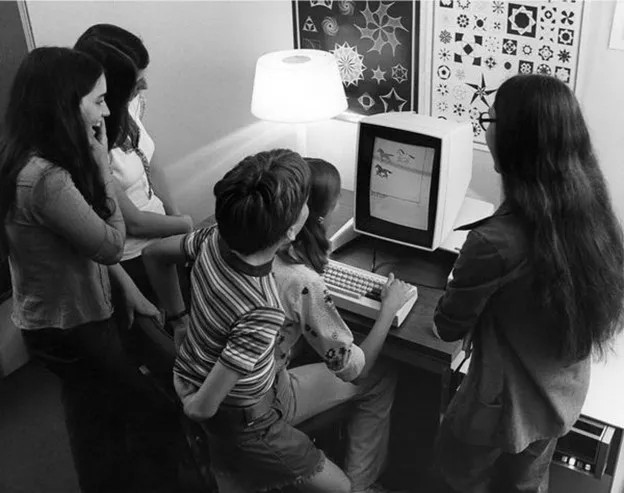
Children animating horses using Smalltalk-72 on an Alto computer. Courtesy of the PARC Library. © PARC. CHM Object ID 500004466
When Children Have Something They Truly Want to Create
In the 1970s, when computers were still rarities confined to a few research institutes, government agencies, and massive corporations, a lab in Palo Alto, California, embarked on a bold experiment: bringing computers to a local junior high school to teach teenagers how to program and let them create whatever they desired.
This lab had just invented an incredibly simple programming language called Smalltalk. At first, however, they had absolutely no idea how to teach kids to write code. The children stared at the syntax rules, completely unaware that these were the magic spells capable of creating anything.
After weeks of effort and trying various approaches, they finally succeeded.
A 12-year-old girl spent two weeks writing a drawing program that closely resembled MacDraw, which wouldn’t appear on Apple computers until nearly a decade later;
A 15-year-old boy, fascinated by radio but tired of drawing circuit diagrams by hand, built himself a CAD tool for circuit schematics that outperformed a system described in a contemporary Ph.D. thesis;
Another girl, who loved animation, wanted a moving horse and a jockey to appear in the same picture, so she rewrote the code to add a feature that even professional animators hadn’t thought of…
They discovered that when these children had something they truly wanted to build, they unleashed astonishing creativity.
Alan Kay’s classic 1987 lecture: “Doing with Images Makes Symbols: Communicating with Computers”
The driving force behind this was computer scientist Alan Kay and the Xerox PARC laboratory. The graphical user interface born here was subsequently borrowed by tech giants Apple and Microsoft, shaping how we use every screen-based device today; the object-oriented programming they defined became the foundation for almost all modern programming languages. Kay himself famously declared: “The best way to predict the future is to invent it.” In 1972, looking at a palm-sized plasma display capable of lighting up only a few dozen pixels, he saw the potential of mobile computing and envisioned a device remarkably similar to today’s iPad, forty years ahead of its time.
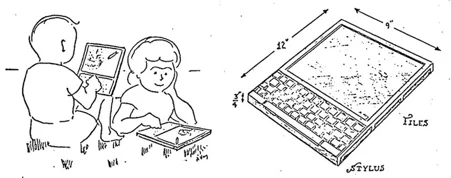
Illustration from Alan Kay’s 1972 proposal “A personal computer for children of all ages”, depicting a device called Dynabook
Behind all these inventions was a common thread — Kay’s great vision — to transform the complex, hard-to-use computer into “paper and pencil,” into “training wheels,” and into a “medium” designed to “help people become better thinkers and creators.”
The Shared Dream of Computer Pioneers
In fact, this wasn’t just his personal ambition; it was the shared dream of generations of pioneers since the dawn of computing.
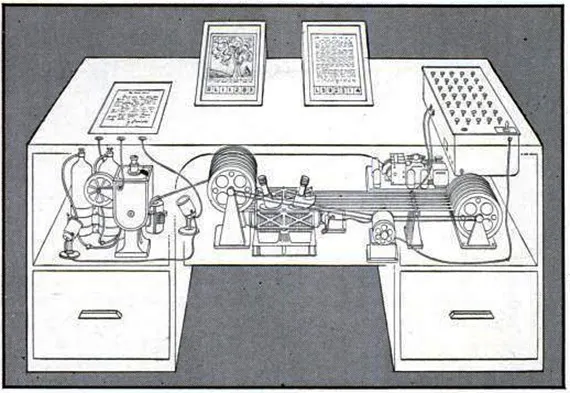
Illustration from Vannevar Bush’s classic article “As We May Think” in Atlantic Monthly (July 1945 issue), pp. 101–108; Read online: http://www.theatlantic.com/doc/194507/bush
In 1945, Vannevar Bush, the head of the U.S. Office of Scientific Research and Development during WWII, envisioned the Memex, widely considered the common ancestor of the hyperlink, the internet, search engines, and the personal computer. The original intent of cramming a library into a desk was to help humanity cope with an era of information explosion.
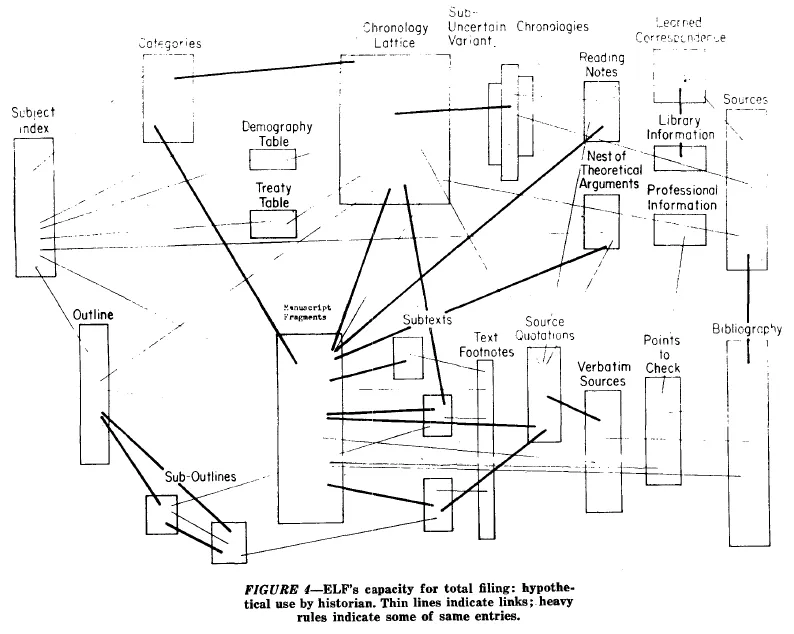
Illustration from Ted Nelson’s 1965 paper “A File Structure for the Complex, the Changing, and the Indeterminate.”
In the 1960s, inspired by the Memex, Harvard graduate student Ted Nelson coined the terms Hypertext and Hyperlink and launched the first hypertext network project in human history (predating the World Wide Web), attempting to build the ultimate medium for humanity to express thoughts, eliminate prejudice, and reconstruct human knowledge.
In 1968, computer scientist Douglas Engelbart gave a live demonstration later dubbed The Mother of All Demos. Using a mouse, in a single afternoon, he introduced the world to windows, hyperlinks, remote collaboration, and real-time co-editing for the very first time. He later summarized his life’s work in three words: Augmenting Human Intellect.
Bush focused on knowledge. Nelson focused on interconnection. Engelbart focused on collaboration. Kay focused on simplicity. But they were all pointing to the exact same place: the goal wasn’t to have machines do things for people, but to help people think further.
Unfortunately, the technology of the time couldn’t match such grand ambitions, and these ideals gradually drifted off course over the following decades.
For the past half-century, the friction of “execution” has simply been too high. To turn an idea into reality, humans had to learn complex software, decipher obscure code, and navigate tedious workflows. To accommodate this high-intensity execution, computers steadily regressed into highly efficient “execution machines.” What ultimately landed on our desks were word processors that mimicked physical paper, web pages with one-way links, and isolated, siloed editors.
And then AI arrived, completely shattering the barriers of the execution layer.
Moving to the Far Left of the Meta Workflow
With the maturation of AI Agents, we suddenly realize that the software skills and professional workflows we spent years mastering are rapidly becoming obsolete. AI has become the ultimate “Universal Tool”. The anxiety of being replaced has rippled across every industry.
Faced with this precipitous shift, many people’s immediate reaction is panic, trying to learn “how to use AI.” But they fail to realize that this in itself is a paradox: the direction of AI’s evolution is to eliminate all barriers to using tools. As AI gets better at proactively understanding your fuzzy instructions, tool usage skills will cease to be a barrier. AI has transformed from a Copilot you need to guide step-by-step (AI Assistant) to a fully autonomous self-driving car (AI Agent).
However, you probably cannot just toss the steering wheel to AI and walk away. First, AI has no intent because it lacks self-awareness. Second, every word and every pixel spat out by AI costs compute and energy; you cannot let it act like Doctor Strange, evaluating 14,000,605 alternate timelines before making a single move.
Since the car can drive itself, the only question that matters becomes: Where do you want to go? — This is intent.
Thus, we have arrived at a historic convergence between AI and the long-lost visions of the pioneers. As machines take over the heavy lifting of coding and design execution, we are finally liberated. We can return to the exact place Alan Kay and Engelbart pointed to from the start — the far left of the meta-workflow.
The paradigm shift
In the past, the boundaries of our creations were dictated by “what I know how to do” and “what I have learned.” Today, our paradigm of thinking has fundamentally inverted — the boundaries of creation in the future will depend solely on “what is possible” and “what I want.”
When AI can execute everything, and even act autonomously at bandwidths and speeds far exceeding ours, the bottleneck in the “intent-execution” chain shifts historically. The bottleneck is no longer the machine’s computing power or execution capability, but human cognitive bandwidth. As AI runs faster and faster, the speed at which humans can generate high-quality intent paradoxically becomes the slowest link in the entire chain.
The bottleneck shift
Because of this, good intent will always be scarce. To break the bottleneck of the human brain’s bandwidth, and to prevent fragile intent from dragging down powerful AI, we need new mediums and systems. The work and exploration humans undertake around intent in this new paradigm is what I call Intent Engineering.
What is Intent Engineering
The essence of Intent Engineering is to capture intuition and translate it into a clear direction that can be executed.
But first, we must understand what intent actually is. It is not a finalized requirements document, nor is it a fully-fledged blueprint. The core of intent is a kind of tension.
That palpable gap between reality and the ideal — that is intent. It acts like a taut rubber band, or the negative space in architecture waiting to be filled, pulling you to create, to restore equilibrium. The generation of intent is a human instinct, deeply intertwined with every individual’s emotions, desires, values, and tastes.
To translate this raw tension into a definitive direction, the most critical method is to ask better questions — to ruthlessly interrogate what is the true reality and what is the true ideal.
Therefore, a good intent is exceptionally rare because it must simultaneously satisfy stringent conditions across three dimensions.
It requires immense Breadth. Intent is limited by the space of possibilities a person can imagine; you cannot think of something you do not know exists. As Steve Jobs said, “Creativity is just connecting the dots.” Good intent inevitably encourages an expansive field of vision and non-linear connections.
It requires extreme Depth. It cannot stay on the surface; it must relentlessly ask “why” until it hits the bedrock of the matter. As the famous adage goes: “Nobody actually wants a drill; they want a hole in the wall. Or rather, they don’t even want the hole; they want to hang a painting, to make a house feels better.” Feynman’s father taught him a lifelong lesson: “You can know the name of that bird in all the languages of the world, but when you’re finished, you’ll know absolutely nothing whatever about the bird.” Good intent always originates from insight into the real problem.
Most importantly, it must Flow. A great idea is never perfectly formed before the journey begins. Intent is never a static instruction manual handed off to an executor once written; it is a living entity continuously revised during the creative process. A sculptor’s imagination right before striking the first blow can never be identical to the imagination guiding the final chisel.
If intent is such a vast, profound, and constantly flowing tension, how should we go about containing it?
Making Better Thinkers
Most of the time, the tools we build are designed to do one thing: compress the distance between “thinking” and “getting.” But in doing so, they have often rigidly solidified our thinking in a rather crude way.
In the past, we grew accustomed to facing a blinking cursor, flattening complex thoughts into lines of text within a document that scrolls linearly downward. Today, we sit in cramped chatboxes, hoping a single, perfect Prompt will summon a miracle. Any such “one-shot input” container fundamentally falls short of the complexity of the human mind.
If we acknowledge that intent is broad, deep, and ever-flowing, we must also admit a hard truth: When you are confined to a linear input box or a rigid workflow, your intent itself becomes compressed.
To become better thinkers in the AI era — that is, to perform better “Intent Engineering” — we must completely break free from these shackles. We no longer need simulations of paper or typewriters, nor should we reduce ourselves to mere rubber stampers handing off approvals to artificial intelligence.
What we require is a medium capable of hosting divergence, connection, and non-linear thought. We stand once more on the threshold of the pioneers’ half-century-old dream, now propelled by AI and a host of emerging technologies.
Within this “space for thought,” fragile fragments of inspiration can be scattered freely, ideas from different dimensions can be juxtaposed intuitively, and non-linear connections are omnipresent. Meanwhile, AI will play the dual roles of both thinking partner and execution tool. It can catch the sparks ignited by your cognitive tension, co-deduce and shape them with you, and truly understand your goals to generate outcomes that perfectly align with your intent.
Only when our tools truly match the nature of intent engineering, will the boundary of human creation no longer be the gravity of execution, but the sheer edge of our imagination.
This essay is also published on Medium.