The Meta Workflow
Why AI Will Collapse Every Layer Between Intent and Outcome, and What It Will Never Touch
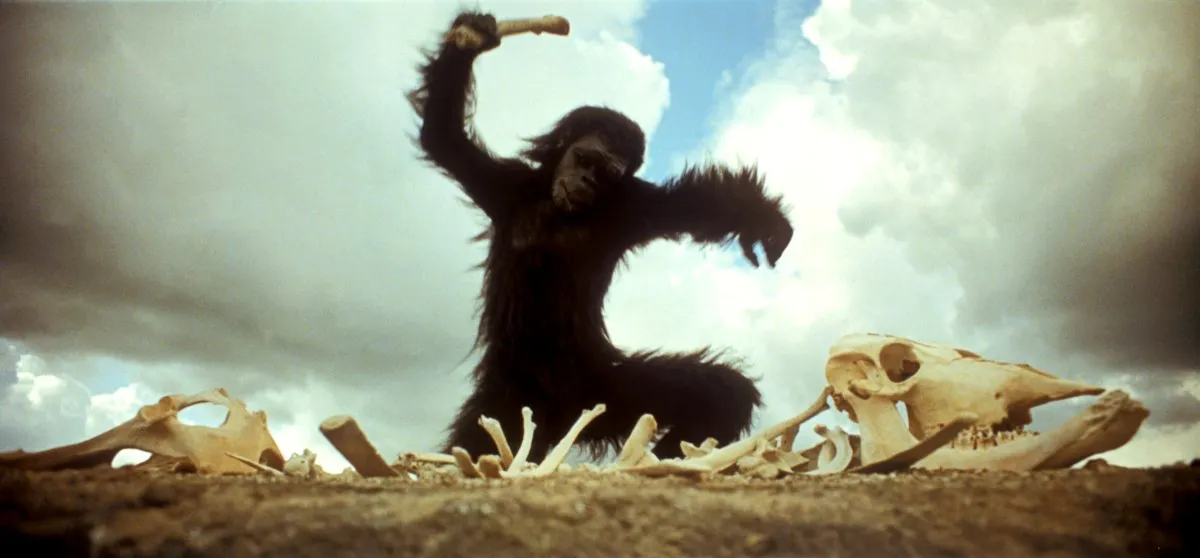
2001: A Space Odyssey (1968), directed by Stanley Kubrick, produced by Metro-Goldwyn-Mayer
In the opening of 2001: A Space Odyssey, a tribe of apes struggles to survive in a barren African wilderness millions of years ago. Under the spell of a mysterious black monolith, the leader of the tribe stumbles upon a discovery: an animal bone can be used to smash other bones, to crack open food. In that moment, our ancestors grasped the idea of a “tool”— the single most critical step from animal life to civilization. The ape hurls the bone into the sky in triumph; through the most famous match cut in film history, it becomes a spaceship gliding through the vastness of space.
From bone to spaceship, the pattern is the same. A pattern that hasn’t changed in millions of years:
Humans want something, so they find a tool, and they make it happen. The full path looks like this:
Wanting to eat (intent) → eating the food (expected outcome) → trying out this bone (exploration) → using the bone to crack food open (execution) → achieving the goal (result)
The meta workflow
Sometimes it takes more than one attempt: detours, adjustments, repeated tries. Sometimes, after enough experience has been passed down, exploration disappears from view. But the basic pattern has held for millions of years. It still shows up in ordinary life every day:
Want to wake up → use a coffee machine → a cup of coffee
Want to present at work → use the Office suite → a document
Want to design a product → use Figma → a prototype
I call this the meta workflow. No matter how tools and eras change, the structure of human work has never shifted: intent on the far left, result on the far right, and execution in between.
But execution itself has been changing all along.
For a very long time, humans completed nearly every step of the meta workflow by hand. We still call those who insist on making things by hand “craftsmen” — a word that itself points back to an ancient condition: no distance between human and tool, where execution is the work.
Two industrial revolutions changed everything.
The steam engine, the internal combustion engine, factories, and assembly lines — they automated most of the execution that required muscle. Physical labor was taken over by machines, freeing up human time and energy to move further upstream in the meta workflow.
That “upstream” is mental labor.
There’s a subtle point here: mental labor is not free of execution. Designers draw blueprints, engineers write specifications — these are all forms of execution, just in a different form. What really changed was the ratio. In the age of craftsmen, the work closest to intent — ideation, judgment, choosing a direction — may have taken up only 10 to 20 percent of the job, with the rest consumed by physical execution. After the Industrial Revolution, that small upstream slice could become the main body of the work.
The result was an explosion of creativity. A single Zara store today might produce more new designs in a month than a preindustrial society produced in a century.
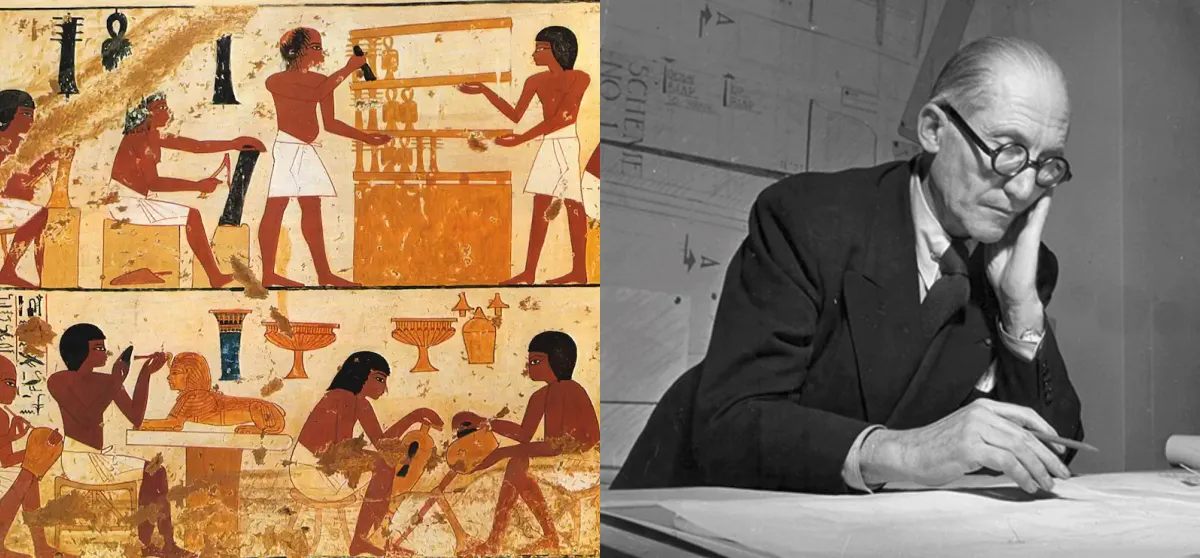
left, a reconstructed workshop mural from the Tomb of the Two Sculptors in Thebes, ancient Egypt; right, Le Corbusier at his desk, University of Wisconsin-Madison Archives / UW Digital Collections
This was the first paradigm shift: from craftsmen to designers and engineers.
But it’s worth pausing here to notice something. After the Industrial Revolution, not everyone became a designer or an engineer. Most people went into factories, doing mechanical, repetitive labor. We don’t call them craftsmen — not because they stopped working with their hands, but because intent had vanished from their work. The assembly line turned execution into repetition, and people into cogs.
The ones who truly moved upstream were those who kept intent alive in their work.
Today, the same story is unfolding once again.
AI models are the steam engines of this revolution. AI agents are the assembly lines and factories. The difference is that what’s being automated this time isn’t muscle — it’s intelligence. Their role, therefore, is to automate the execution layer of most mental labor.
Right now, this wave is concentrated where it can have the fastest and most visible impact: programming, law, scientific research. But it won’t stop there. Anything that requires intelligent execution will eventually be swept in.
This has made a lot of people anxious: what jobs are about to disappear? What irreplaceable value do humans still have?
That anxiety is entirely justified. A new paradigm shift is coming. But there’s no reason to feel lost, because if you look through the long arc of history, a direction begins to emerge:
The paradigm shift (1)
With every leap in tools, the core value of being human shifts further upstream in the meta workflow — closer and closer to intent.
Some say: even if AI takes over execution, humans can still do more creative, more original work. That sounds comforting, but it dodges a more fundamental truth. Creativity depends on massive amounts of execution too — writing code to realize an idea, running experiment after experiment to test a hypothesis, sketching dozens of variations to explore a design. And that execution is being eaten by AI. AI can read in one second the books that would take you a month. It can explore a hundred experimental directions at once. It can reach expert-level proficiency in almost any domain in no time — not because it’s smarter than you, but because execution itself has been automated.
If “smart” and “creative” are no longer human advantages, then what space is left for us?
The answer is hiding at the far left end of the meta workflow.
AI, no matter how capable, will not have intent — not in any foreseeable future. It will not wake up at 3 a.m., stare at the ceiling, and feel that something must be created. It will not have a thought arrive, for no reason at all, and just want to try. It can write about daffodils, but it has never wandered lonely through a field and carried that memory home.
Without intent, it remains a tool. Even an intelligent one.
Of course, maybe one day AI will genuinely develop intent. If that day comes, we can only pray that the AI overlords of science fiction take their time arriving. But until then, the steering wheel stays in human hands. We can hand over execution — and even most exploration — to AI with confidence.
Because we will ultimately repeat the pattern of the previous paradigm shift:
The paradigm shift (2)
- Move upstream in the meta workflow, closer to intent.
- Shift 80 to 90 percent of our time and energy toward the upstream work that today still looks like a small slice of the whole.
- Creativity will explode once again. But just like last time, it won’t belong to everyone automatically — the ones who truly move upstream will always be those who hold onto intent.
- As long as intent cannot be replaced, human value endures.
If AI is a magic wand that strikes wherever you point it, then what we need to do is know where to point.
Everyone has intent. But good intent is rare.
AI is a universal tool — it will even try, on its own, to understand your intent. So the real differentiator is no longer who is better at using the tool. It’s knowing what to do once you have a tool this powerful. Good intent means knowing what you truly want, what is worth creating, what is possible to create and why to create. This will become the most important capability of the AI age.
Recently, many have called this capability “taste.” But I think that word is misplaced. Taste usually means: having seen enough good things, internalizing them into an intuitive sense of what’s good and what’s not. This sounds compelling — but it describes exactly what AI is best at. The better the training data, the better AI’s “taste.”
What is truly scarce is not taste, but intent — specifically, good intent: the clarity to know what to do amid infinite possibilities.
That sounds simple. It’s extraordinarily hard.
Because this kind of intent is not something lying on the ground, waiting for you to bend down and pick it up. It needs to be discovered, developed, and allowed to emerge through accumulated experience and collisions between ideas. Some call this process ideation. Steve Jobs called it “connecting the dots.”
Creativity is just connecting things. When you ask creative people how they did something, they feel a little guilty because they didn’t really do it, they just saw something. It seemed obvious to them after a while. That’s because they were able to connect experiences they’ve had and synthesize new things. And the reason they were able to do that was that they’ve had more experiences or they have thought more about their experiences than other people. Unfortunately, that’s too rare a commodity.
― Steve Jobs
While everyone else is racing to make the magic wand more powerful and more reliable, someone has to solve the problem of “where to point.”
If this is where humanity is about to spend most of its time and energy, is there a way to help people do it better?
That’s a question I’ve been thinking about.
This essay is also published on Medium.