The Intent Flywheel
Stepping Away from the Input Box to Create Better Mind Tools in the AI Era

The Birth of Minerva, by René-Antoine Houasse (c. 1645–1710) (Minerva in Roman mythology corresponds to Athena in Greek mythology, the goddess of wisdom and war, who was born fully armed from the head of Jupiter, i.e., Zeus)
Thinking Requires Tools
In his writing class, University of Chicago professor Larry McEnerney shared a profound insight that left a deep impression on me:
(Most of the time) The thinking you are doing is at such a level of complexity that you have to use your writing to help yourself do your thinking… (In high school) I thought everybody else, when they did this thinking, just thought it till they were done, and then their essay, like Athena, burst from their forehead onto the page… Nobody works that way!
This part struck me at the time and convinced me of one thing: thinking requires tools. Language is one of the oldest and most fundamental example.
While we could certainly think before language existed, the ability to understand, collaborate, and communicate ideas would have been far more difficult without it.
Cognitive scientist Daniel Dennett proposed a similar view. He argued that the biological human brain has no insurmountable hardware gap compared to monkeys and apes. The reason humans experienced an explosion in intelligence is that we invented language and downloaded it into our brains as “Mind Tools.” Much like installing an operating system on a silicon chip, language allowed the brain to master categorization, memory, abstraction, and recursion.
This theory finds a fascinating resonance in the AI era — the reason AI can exhibit astonishing reasoning capabilities is precisely because it uses language as a tool to deduce logic.
Of course, language isn’t the only “mind tool.” Even older than language is our capacity for spatial and visual thinking. As toddlers, we all counted on our fingers — understanding the spatial meaning of “3” long before grasping its abstract concept. When faced with intricate relationships, our instinct is to sketch them out, relying on physical proximity, spatial arrangement, and connecting lines to transcend the linear boundaries of language.
To further expand our brains and think through more and more complex problems, humanity has a long history of inventing mind tools:
- There are physical tools, such as whiteboards, sticky notes, and Zettelkasten…
- There are conceptual tools, such as spreadsheets, mind maps, and brainstorming…
- There are software tools, such as word processors, slides, and bidirectional linking notes…
Every tool, in essence, is a cognitive scaffold we build for complex thoughts and intentions, helping us become better thinkers and creators. In the AI era, we naturally demand better mind tools.
The Silos
However, looking around today, these meticulously crafted mind tools mostly function in isolated silos within the traditional software ecosystem, leading to significant fragmentation and friction.
From my perspective, there are 4 types of silos:
1. Data and Format Silos
The most crucial part of Intent Engineering is establishing non-linear, networked connections.
Recall your usual workspace: the active file sits centrally, surrounded by reference materials, drafts, and sticky notes within easy reach. Our brains are highly accustomed to this spatial arrangement; a quick glance allows us to naturally jump between the core task and background information, weaving connections.
Yet, when these tools were moved into computers, this spatial experience was ignored. We were confined to the obsolete metaphor of paper. Ted Nelson, who coined the concept of hypertext, once wrote angrily: “Simulating paper on a computer screen is a betrayal of the digital medium.”
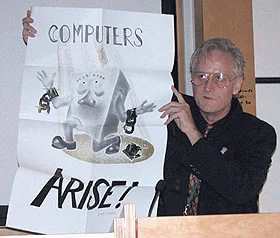
Ted Nelson keynote at the ACM Hypertext 03 conference in Nottingham. Photograph by Tim Brailsford.
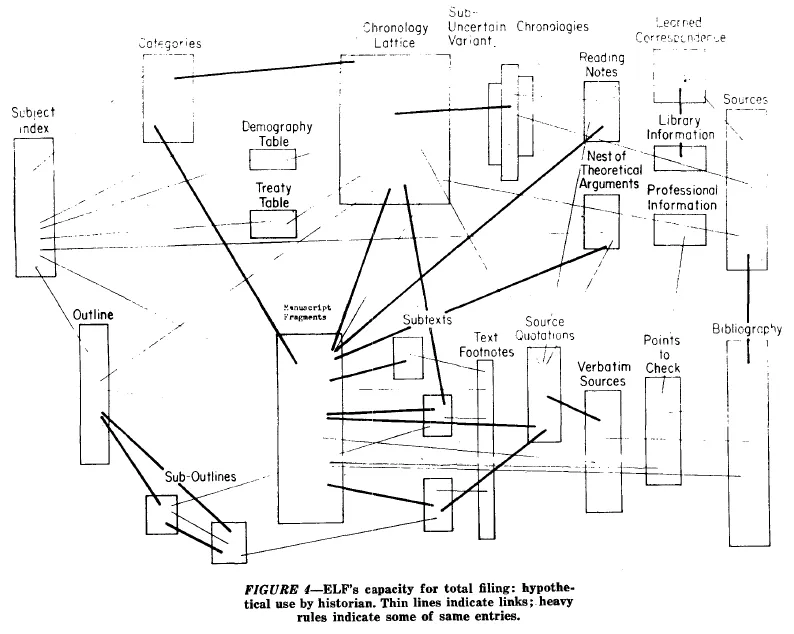
Illustration from Ted Nelson's 1965 paper "A File Structure for the Complex, the Changing, and the Indeterminate".
2. Operational and Interaction Silos
Thinking is an extremely fragile state of flow. But traditional systems forcefully insert countless interactive barriers into our mental flow.
Apple’s OpenDoc project in the early 90s attempted to change this with a “document-centric” approach, but it ultimately failed due to the technical limitations of its era, leading the software ecosystem toward an “application-centric” paradigm.
As a result, when we develop an idea, we must frequently switch between dozens of browser tabs and massive professional software. Every switch is a ruthless interruption of our flow.
Apple OpenDoc original video footage
3. Functional Silos (Understanding, Collaboration, Communication)
Understanding, collaboration, and communication — each direction has useful tools, but they are individually just links in a chain.
Not only do we have to cultivate different mindsets and skills for them, but we must also endure clunky, friction-filled transfer processes when switching — sketching on a whiteboard, copying it into a document to write the logic, and finally taking a screenshot to paste into slides for presentation.
The tension of intent dissipates continuously during this inefficient cross-medium transit.
4. Contextual Silos
In the AI era, we have encountered a brand new silo: the contextual silos between human and AI.
The wave of generative AI is surging, yet the way we collaborate with AI is still that cramped chat input box (Chatbox).
The input box defaults to a premise: the user already knows what they want to ask. It is highly suitable for linear input and linear follow-ups. But in complex creative tasks, the user’s biggest dilemma is often not “not knowing the answer,” but not yet having their own Intent clearly organized.
Current Context Engineering, Harness Engineering and LLM Wiki are almost exclusively optimizers designed for AI, not cognitive scaffolds designed for humans. Faced with human intents that have not yet taken shape, AI often rushes to produce outputs, overwhelming us with excessive "options" or hastily converging on a single "correct" answer — one that lacks human scrutiny. In doing so, it fails to provide the meaningful feedback needed to genuinely advance our ideas.
Without creating a new medium/tool that allows both parties to be “co-present,” AI, sprinting ahead on its own, will eventually leave humanity’s fragile and complex intents far behind in a black box.
When Intent Flows in A Continuous, Frictionless Space
To break down these four silos, we need an entirely new medium/tool. Let’s step out of the input box/editor model, and imagine this scenario:
You are conceptualizing the interior layout of a cafe. On the screen in front of you is a free space with no borders.
Conceptual mockup of a continuous frictionless space for intent
On the left, you drop a blank floor plan and casually draw the customer’s walking path from the entrance; on the right, you jot down a few intuitive thoughts about “lighting” and “atmosphere”; then, using rough arrows, you connect the movement line to the window seats, and pin a few minimalist visual reference images nearby.
Then, you lasso this area and say to your AI assistant, “I want to see what a customer will see at first glance when they walk from the entrance to this point.”
The AI Agent "understands" everything spread out. Just a few seconds later, right next to your floor plan sketch, the Agent follows your intent and directly "grows" an interactive 3D real-scene prototype complete with lighting effects.
You gain a more intuitive understanding of your design. Realizing the counter’s position blocks the best view of the cafe, you simply erase and redraw a few strokes directly on the floor plan sketch.
Like a stone cast into water creating ripples, as your hand makes the modifications, the interactive view next to it instantly and automatically updates the layout.
Subsequently, you say to the AI: "I want to share this with my friend." Seconds later, an immersive webpage is born. The real-time rendered effects, reference images, and finalized text thoughts are perfectly integrated.
Better Mind Tools in The AI Era
The scenario above reveals the medium/tool truly capable of carrying Intent Engineering.
In the AI era, humans should no longer downgrade their thinking to accommodate the machine's shape. I believe the next generation of mind tools must meet the following criteria:
1. Eliminate Friction to Let Thought Flow Without Loss
Human working memory is extremely limited. The first three silos mentioned earlier—data formats, operations, and tool purposes—make the friction required to use these tools become excessively high. Instead of helping us think and create, the tools themselves become the primary task, demanding extensive training and refinement just to use them effectively.
The first rule of the next-generation mind tool is to create a continuous, frictionless space to eliminate these silos. For visual thinkers, a “shared infinite canvas” is an excellent choice. On the canvas, application barriers are broken down, information is no longer sealed inside isolated files, and intent flows across different modalities like images and text. This frictionless environment allows human cognitive bandwidth to be 100% reserved for creation and thinking itself.
2. Use Fluid Mind Tools to Empower Thinking
Moving beyond the traditional software ecosystem does not mean discarding the great mind tool inventions of history. On the contrary, we can better utilize them in a zero-friction space.
Computer pioneer Alan Kay once redefined the personal computer as a “Metamedia” — the “first medium that could encompass and simulate all other known media, and catalyze entirely new media.”
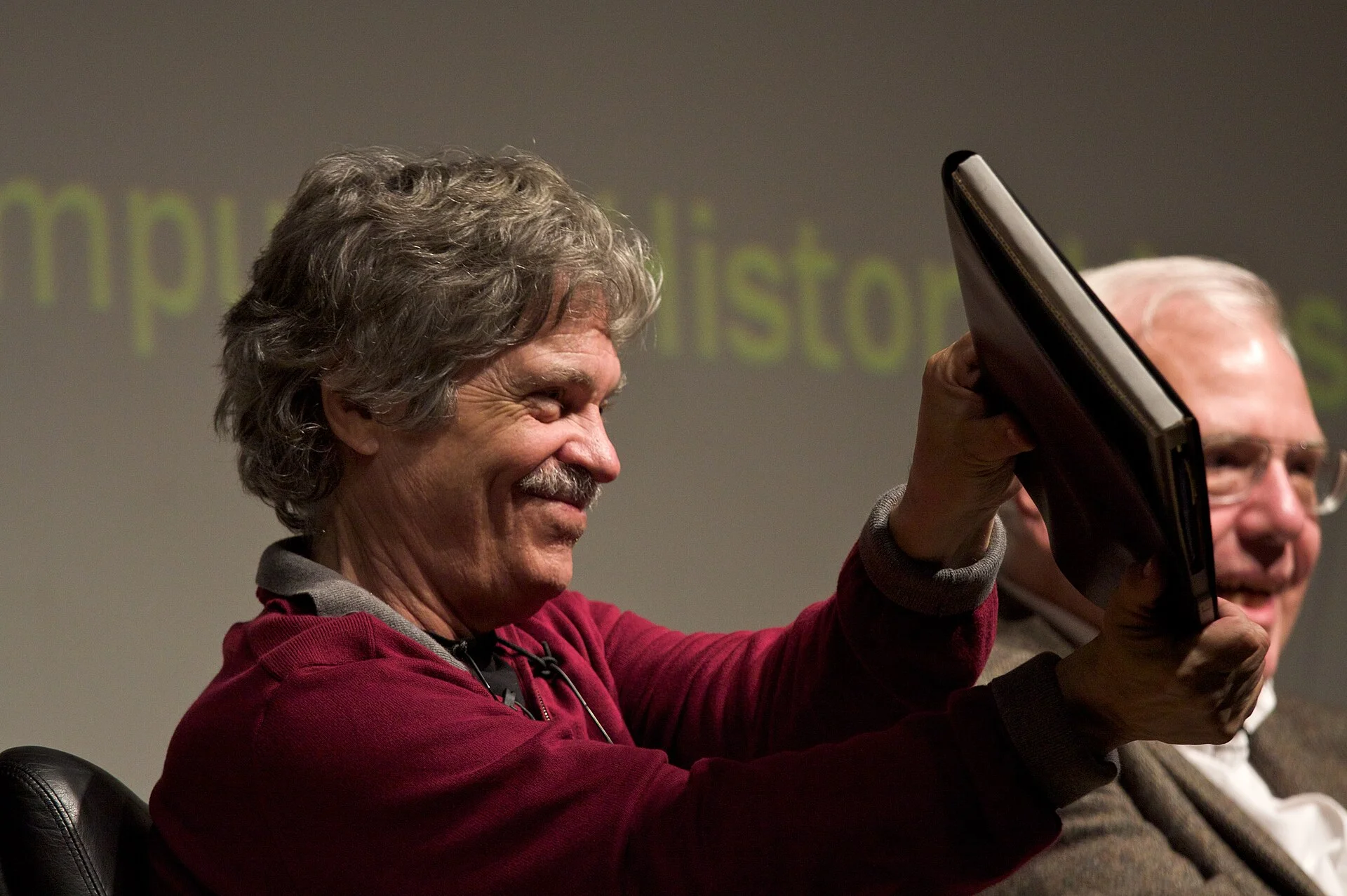
Alan Kay holding the mockup of the Dynabook
In the Generative-AI era, we are pushing the concept of "metamedia" to the extreme: a block of text can easily expand, shrink, or toggle between rigor and simple clarity; it can transform into an image, then into music, video, a webpage, or even runnable software. Concepts and ideas present fluid-like physical properties across different media.
When your intent expands, a mind map naturally emerges; when you need rigorous contrast, a spreadsheet is ready; when you want to feel the final effect, an interactive prototype leaps before your eyes. In this fluid system, tools are no longer static cages for your ideas, but rather flow along with your intent.
3. Share Context for Cognitive Symmetry with AI
In this zero-friction space, all mind tools, along with their spatial relationships and networked connections, naturally constitute a context network. When shared with AI, it serves not only as a cognitive scaffold to help us process complex thinking but also as the best interface for precisely conveying intent to the AI execution layer.
Consequently, you no longer need to rack your brain restoring context in front of a cramped input box. Because AI now co-inhabits your cognitive space, sharing a symmetrical information network.
Thanks to AI's powerful semantic understanding and execution capabilities, managing knowledge and information will no longer feel tedious. Every move, connection, and modification you make silently deepens its understanding of your intent; the AI can even proactively execute full-scale iterations along the web of connections, triggering a "ripple effect" of creation.
This is by no means letting AI think for you. On the contrary, when AI and your cognition achieve symmetry, it can accomplish a true i + 1 — providing just-in-time assistance and choices based on a deep understanding of your current train of thought. This precise assistance is far more effective than randomly throwing 99 blind boxes at you that cause cognitive overload.
In cybernetics and systems theory, when the variety of the external environment's input exceeds the internal regulation capacity of a system, the system faces collapse because it cannot absorb these disturbances (law of requisite variety). Unmoored from human intent, AI can provide countless options far exceeding the user's cognitive limits; but only those choices refined through cognitive processing or second-order cybernetics feedback loops ("defining and constructing our own goals") can truly help you focus and push creation forward.
Human-AI Barriers vs. Shared Context
This deep synergy completely restructures the collaboration model between humans and AI:
First, the “Intent → Execution → Result” chain becomes unprecedentedly efficient. In the AI era, the system’s true bottleneck has shifted to “human cognitive bandwidth.” By eliminating cognitive friction, the flow of intent is finally no longer blocked by tedious operations.
Second, it activates an "Inner Loop" of creation: Intent breeds execution, and execution acts as the material to feed back into intent. I call this the "Intent Flywheel". Driven by this flywheel, AI truly becomes the engine for augmenting human intelligence and accelerating creation.
For decades, we have been using isolated tools, forcing our brains to adapt to the shape of the machine. But under the new paradigm of Intent Engineering and the Intent Flywheel, tools finally match the true shape of human thought for the very first time.
This essay is also published on Medium.